Product · Ingenzio
Gitta
A development platform where agents work alongside you.
- Status
- In active development, running on staging
- Access
- By invitation
- Models
- Claude, through OpenRouter, for AI review and agents
- Built by
- Ingenzio
Code, reviews, pipelines and agents, in one place.
Gitta is a place to host code, review it, test it and let agents work on it, all in one system. We built it because adding an agent to an ordinary code host felt backwards. The agent didn't know what it was supposed to do, nobody could see what it did, and its changes looked like anyone else's.
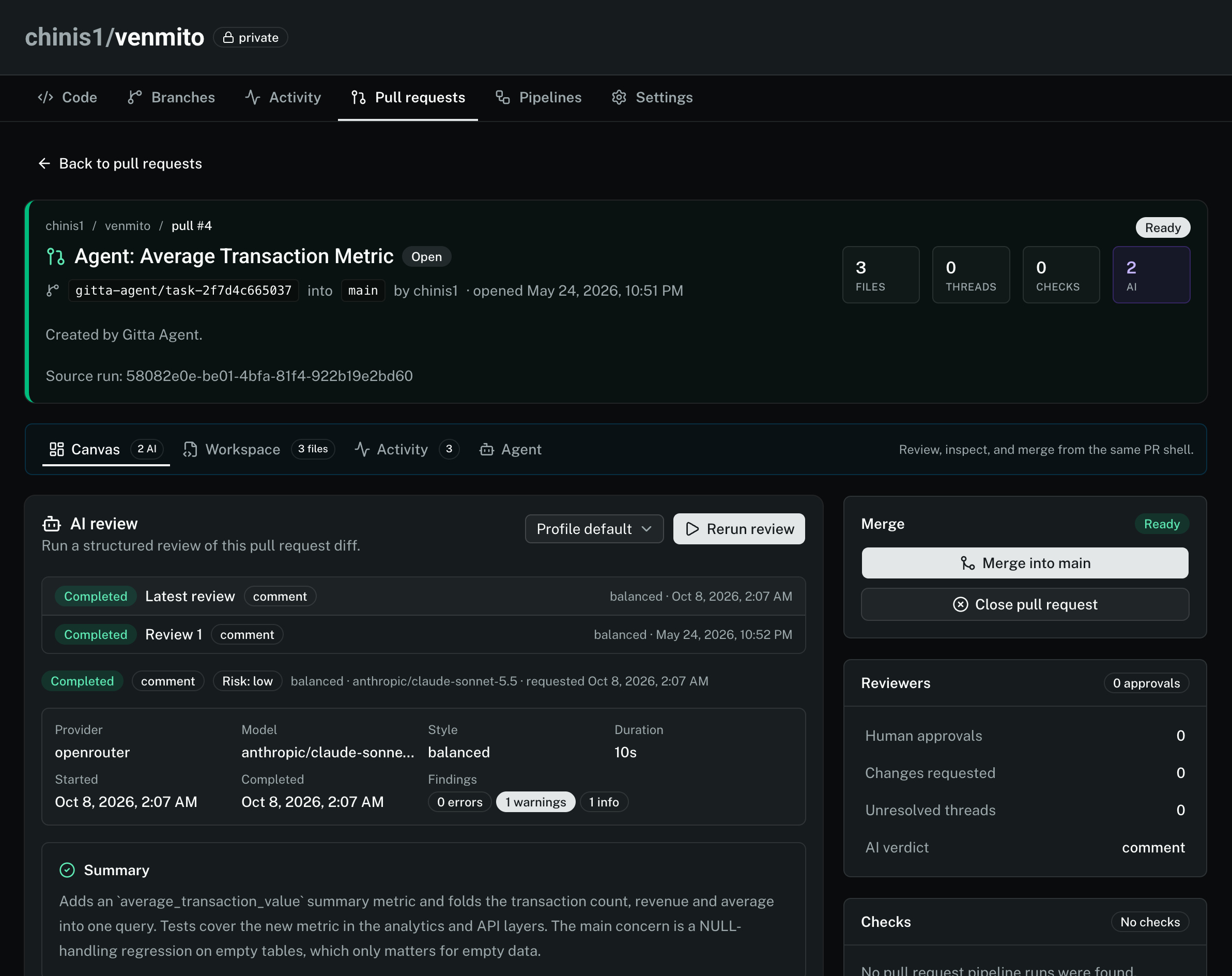
- 1
Opened by an agent.
Gitta Agent opened this pull request from a task, on its own branch, and links the run that produced it.
- 2
Reviewed by Claude.
The AI review read the whole diff and came back with a verdict, a risk level and findings tied to lines.
- 3
Merged by a person.
The merge button lives here, with you. Agents can open pull requests but can't merge them.
- 4
One place for everything that gates a merge.
Approvals, open threads, the AI verdict and pipeline checks.
From a brief to a merged pull request.
If the brief or its list of context files changes after you approved a plan, Gitta marks the plan for review again and won't start the agent until you've looked at it.
- 01
You write a task.
A brief with the goal, the constraints and the files that matter.
- 02
Gitta drafts a plan.
You read it, ask for changes in the chat, and approve it when it's right.
- 03
An agent does the work.
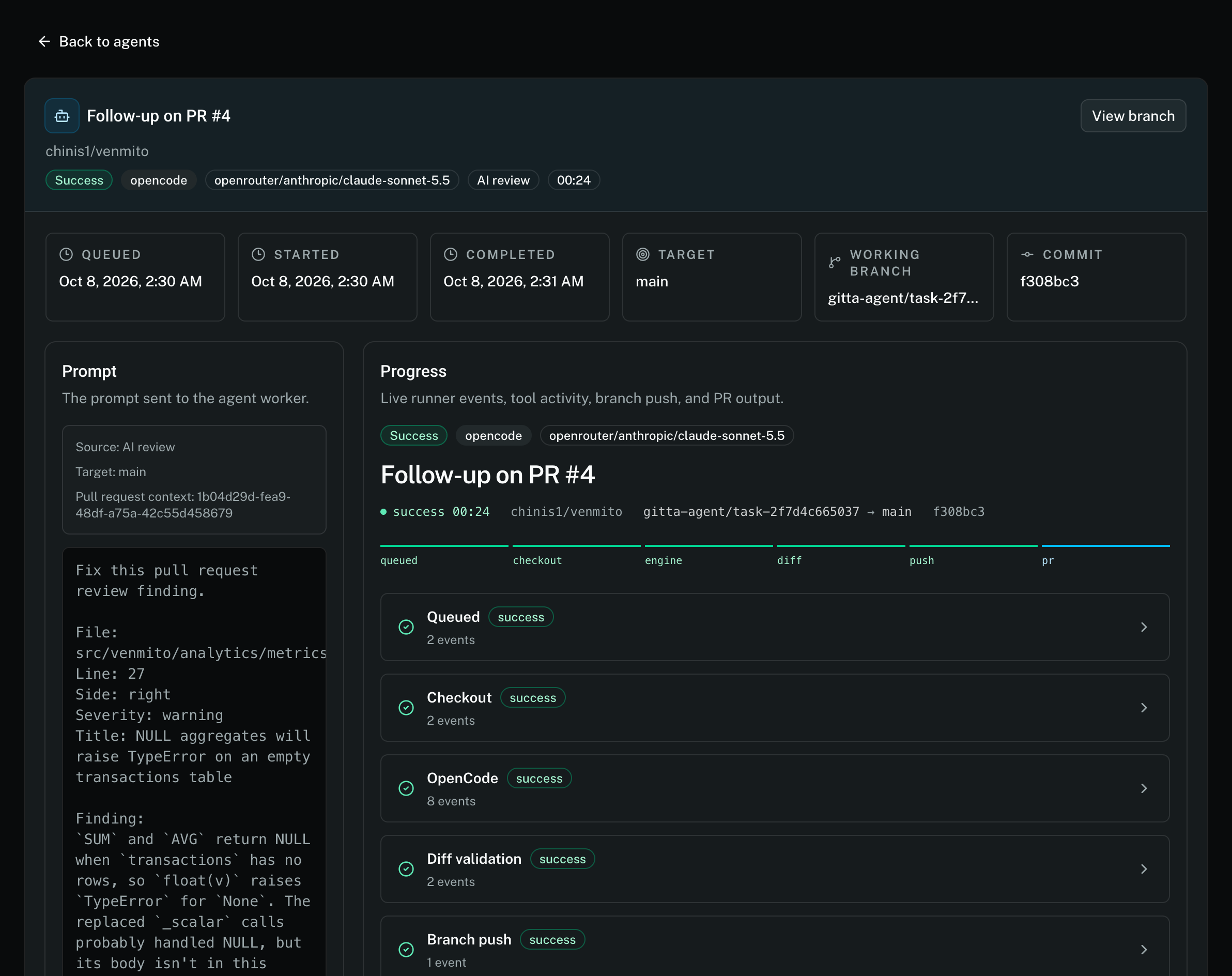
It runs in an isolated container, on its own branch, from the plan you approved.
- 04
The change is checked before it's pushed.
Gitta compares the diff against your repository's rules: which paths are allowed, which files are off limits, how large a change can be.
- 05
A pull request comes back to you.
AI review, your pipelines and your own review all happen there.
- 06
You merge.
Agents can open pull requests, but merging is up to you.
- 1Draft
- 2Planned◆ person approves plan
- 3Approved↺ needs review if inputs change
- 4Running◆ guardrails
- 5PR opened◆ person reviews, merges
- 6Done
Code hosting
Real Git over HTTPS, using the actual git binary, with personal access tokens. Branches, tags, a file browser and commit history, plus pull requests with inline threads, branch protection and merge checks.
Review
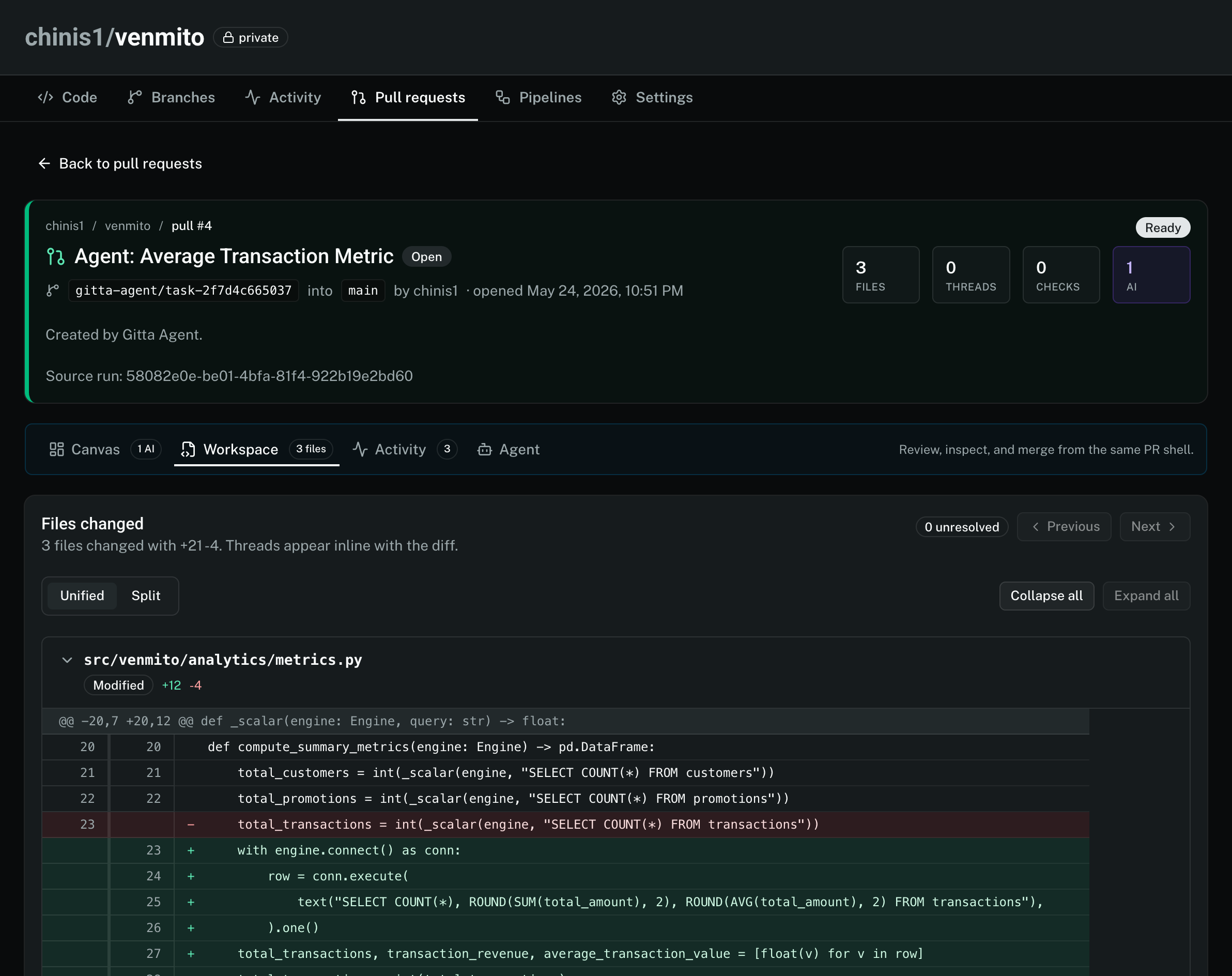
You can ask for an AI review on any pull request. It reads the diff and gives back a verdict, a risk level and findings tied to specific lines. If a finding is worth fixing, one click sends it to the agent, which commits the fix to the same pull request.
Pipelines and runners
Workflows live in your repository. Runners are self-hosted: they ask Gitta for work, run each job in Docker and send the logs back with secrets masked. Gitta itself never runs your code.
Agents and guardrails
Agents start from approved plans and never get your pipeline secrets. Every change is checked against your repository's rules before it's pushed, and you can tighten those rules per repository. Gitta's agents and AI review run on Claude models.
How Gitta is put together.
We split Gitta along its trust boundaries. The API makes the decisions, the git service moves objects around, and runners execute your code on machines the API never touches.
- R1The API never executes repository code.
- R2Runners poll for work. Nothing calls into a runner.
- R3Git operations shell out to the real git binary.
- R4Agents run isolated, without pipeline secrets.
- R5Repository policy can tighten agent guardrails, never relax them.
gitta-web
React app, docs at /docs
talks to gitta-api over HTTPS
gitta-api
Hono · auth · policy · Postgres
owns every product decision
gitta-runner
pipelines mode · Docker jobs
polls gitta-api for jobs
you, or an agent
any git client
pushes over HTTPS with a token
gitta-git-service
Go · real git, smart HTTP
asks gitta-api to authorize every push
gitta-runner
agents mode · OpenCode
polls for runs, pushes guarded branches
fig. 2.3 — service boundaries
Gitta is in active development and running on staging.
Gitta is built by Ingenzio. Access to staging is by invitation while we harden it.