Independent software company · Puerto Rico
Ingenzio builds software products and the infrastructure behind them.
We're an independent software company in Puerto Rico. Our flagship products right now are Gitta and ProjectMesh, two tools for teams that build software with AI agents.
- 13:52:10humanmaya wrote HBR-112 · priority high
- 14:06:12mcpget_project_context(HBR) → 4 repos, 5 rules
- 14:06:41agentpaused on DEC-014: delete or anonymize bookings?
- 14:09:03humanmaya answered DEC-014: anonymize
- 14:09:04agentresumed with DEC-014 in context
- 14:11:50gitpushed agent/hbr-112-account-deletion +268 −41
- 14:11:53runnerrunner-02 claimed API checks #311
- 14:14:34runner126 tests passed in 2m 41s
- 14:22:07humanmaya approved PR #58
- 14:22:09gitmerged #58 into main
- 14:22:10mcpHBR-112 → Done
- ProjectMeshIssueHBR-112—maya writes it
- with the project's contextContextcontext.md4 repos · 5 rules
- get_project_context · in devAgentGitta Agentidle
- asks, and waitsDecisionin devDEC-014—maya decides
- Gitta↓ git pushRepositoryharbor-apimain
- jobRunnerrunner-02polling
- checksPull request#58—maya approves, merges
One change moving through ProjectMesh and Gitta, shown on an example project. Amber marks where a person decides; dashed lines are in development.
The agents got good. The tools around them didn't.
We use coding agents every day, and they're good enough to take on real work now: a feature, a bug, a migration. What kept slowing us down wasn't the agents. It was everything around them. Every new session started without knowing anything about the project. Our code host had no idea an agent had written the change. And after a busy week it was hard to tell what had happened and why.
So we started building the pieces we were missing.
Gitta
A development platform where agents work alongside you.
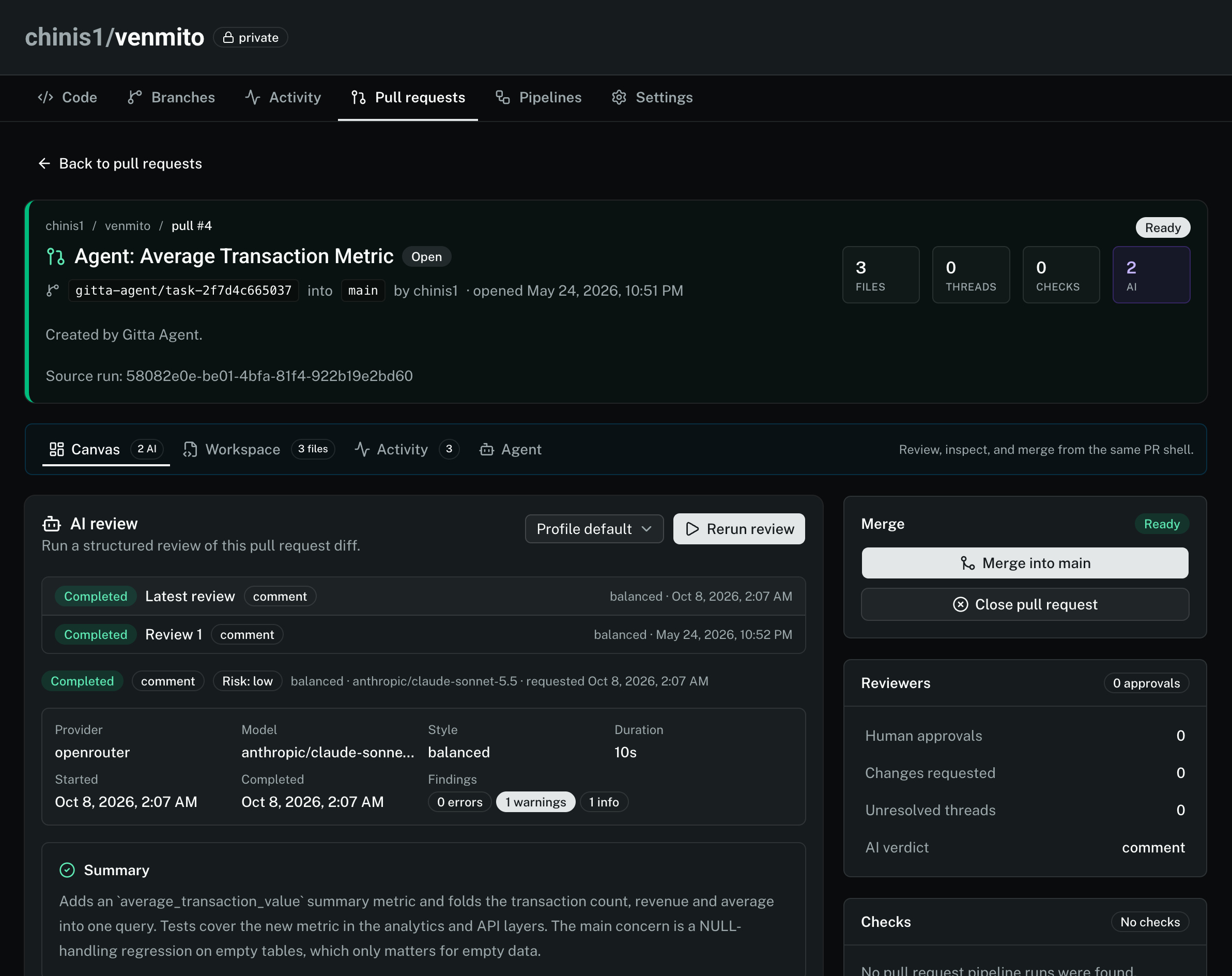
We wanted agents to do real work on a codebase without anyone losing track of what changed. So Gitta has what you'd expect from a code host, plus agents that start from a plan you approved and hand you back a pull request. You decide what merges.
- Git repositories you push to over HTTPS, with pull requests, inline review and branch protection.
- Pipelines that run on your own runners, so your code runs on machines you control.
- An AI review on any pull request, with findings you can send straight back to the agent to fix on the same branch.
- Tasks: you write the brief, Gitta drafts a plan, you approve it, and an agent does the work.
Gitta is in active development and running on staging.
ProjectMesh
The project, written down where agents can read it.
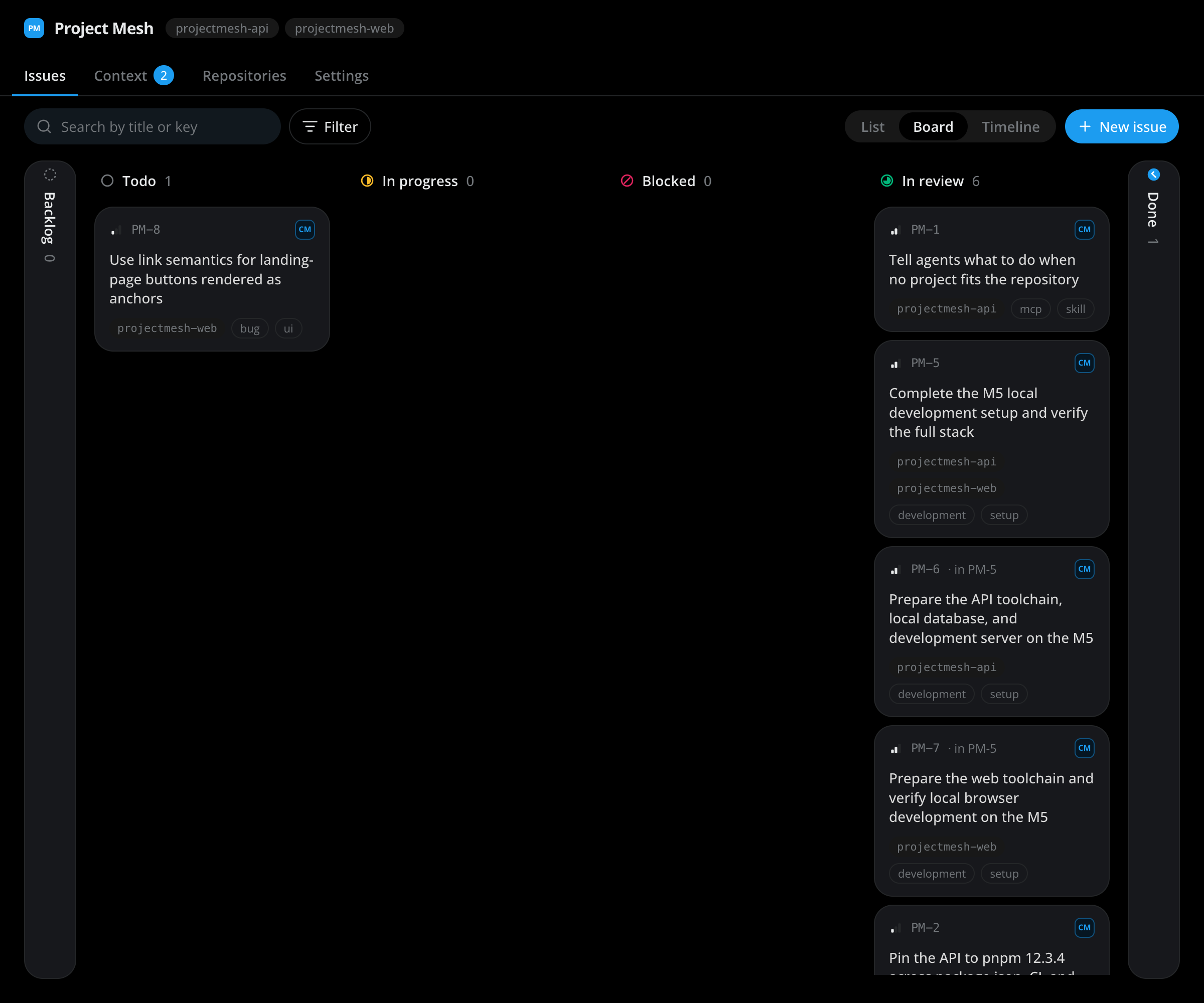
Every time we opened a new agent session we had to explain the project again: how the repositories fit together, what not to touch, what we'd already decided. ProjectMesh keeps all of that in one place. Agents connect over MCP from whatever repository they're working in, read the context, pick up an issue and leave a record of what they did.
- Issues that span repositories, with a list, a board and a timeline.
- One context document that every agent reads first. Agents can suggest changes to it, and we decide whether to accept them.
- Every change is recorded with who made it, whether that's a person or an agent.
- Decision queues, so an agent can stop and ask instead of guessing.in development
ProjectMesh is live in early access. We use it to track its own development, and Gitta's.
How Gitta and ProjectMesh work together.
ProjectMesh knows what we're building and why. Gitta is where the code changes. An agent reads the project in ProjectMesh, does the work in Gitta, and the pull request comes back to a person. Each product works on its own, but we built them to work together.
- 01Human→ProjectMesh
writes HBR-112
- 02Agent→ProjectMesh
get_project_context · get_issue
- 03Agent→ProjectMeshin dev
asks DEC-014, pauses
- 04Human→ProjectMeshin dev
answers: anonymize
- 05ProjectMesh→Agentin dev
answer arrives in context
- 06Agent→Gitta
pushes branch, opens PR #58
- 07Gitta→Runner
job: API checks #311
- 08Runner→Gitta
126 passed
- 09Gitta→Agent
AI finding → fix with agent
- 10Agent→Gitta
follow-up commit
- 11Human→Gitta
approves, merges
- 12Gitta→ProjectMeshin dev
HBR-112 → done
Why these products need strong models.
Both products rely on language models for real work. Gitta's agents write and fix code from an approved plan, and its AI review reads whole diffs. ProjectMesh gives agents the context of an entire project, across repositories, through tool calls over MCP. That takes models that are good with code, long context and careful tool use.
We build with Claude every day. Our engineering runs on Claude Code, and we built and tested ProjectMesh's MCP server with it. Gitta's agents and AI review run on Claude models.
- Gitta agents
- Write and fix code from an approved plan, in an isolated container, then open a pull request.
- Gitta AI review
- Reads a pull request's whole diff and returns a verdict, a risk level and findings tied to lines.
- Gitta tasks
- Turns a brief and its context files into an implementation plan a person approves.
- ProjectMesh over MCP
- Gives any agent the project's context, issues and history through eight tools.
A small, independent team.
We're a small, independent team in Puerto Rico. Engineering leads the work, and a close group of collaborators shapes what we build. Everyone on the team works in Claude every day, so we're our own first users: if something is missing for us, it's probably missing for you too.
We also take on a few client projects when they're a good fit.